
Experienced Building
Specifications and Code Consultants
Specializing in Construction Specifications, Manufacturer Product Specifications, and Building Codes.
Do you have an issue understanding the building code? Is the building department requiring something that you disagree with? Ask the experts...

Follow RLGA Technical Services
RLGA Technical Services is a

Design Team
Architects, engineers, interior designers, and specialty consultants.
Owner Team
Facility managers, project managers, and space planners.
Contractor Team
Construction managers, contractors, and design-builders.
Supplier Team
Manufacturers, distributors, and product representatives.
Ronald L. Geren, FCSI, AIA, CCS, CCCA, SCIP, owner and principal of RLGA Technical Services, is committed to providing his clients with clear, concise, correct, and complete documents, and providing services to enhance the quality of his client's projects.
What's New at specsandcodes.com?
Ron Geren is to be elevated to Distinguished Member
Ron Geren, owner/principal of RLGA Technical Services, will be honored as a Distinguished Member of the Construction Specifications Institute (CSI). Ron has been a member of CSI since 1999 and has held positions at the local, regional, and national levels, including Institute Board Chair. Ron currently serves as Chair for the CSI Foundation Board of Trustees. Read more...

Ron Geren's Book on Building Codes is Now Available
Ron Geren's new book, Applying the Building Code: Step-by-Step Guidance for Design and Building Professionals, is now available through several sources and in multiple formats.
Here is a list of sources where the paperback version of the book can currently be purchased:
Here is a list of sources where digital versions of the book can currently be purchased:
Wiley & Sons (ePub or PDF)
Amazon (Kindle)
Barnes & Noble (Nook)
Apple iTunes (iBooks)
Google Play (ePub or PDF)
eBookMall (ePub)
Kobo (ePub)
The book approaches code application from an entirely different perspective when compared to other books that explain the building code.
Other references for building code books follow the chapter structure of the code book itself, with descriptive or illustrative explanations for the various code requirements.
Applying the Building Code, on the other hand, explains in a step-by-step presentation which code requirements should be looked at and considered during each of the standard design phases: schematic design, design development, and construction documents. Further, the new book is not limited to just the 2015 International Building Code (IBC) but also includes applicable requirements from the International Energy Conservation Code (IECC), International Fire Code (IFC), International Plumbing Code (IPC), and the National Electrical Code (NEC) as applicable to the architectural design profession.
The book also provides an overview of the International Existing Building Code (IEBC) and how the step-by-step process can be modified to address projects associated with existing buildings.
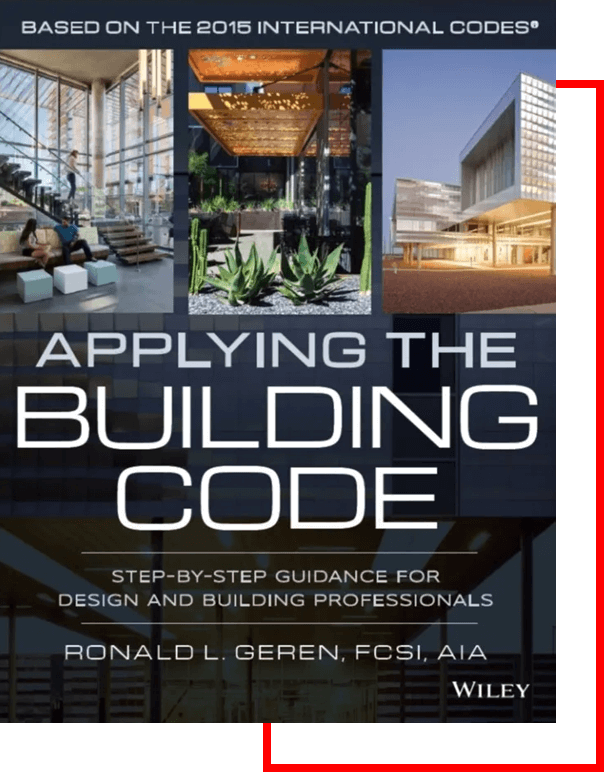
To help explain the step-by-step process, an example project is used throughout the book, explaining how each step is applied based on the information available at that phase. As a bonus, a template for a code data sheet is provided in the appendix to help design professionals organize their code information for incorporation into a set of construction drawings.
New Website Look
Due to a change in support of the website hosting for specsandcodes.com, the site has undergone some changes. The new look is similar, but different, to the former site. If you have any suggestions for improving the website, please send an email to [email protected].